On Jan. 3, the United States launched a military strike on Venezuela and captured the Venezuelan president Nicolás Maduro.
After months of preparation, President Trump gave the final approval of the mission Friday, Jan. 2.
”Good luck and godspeed,” General Dan Caine said Saturday afternoon during a news conference at the president’s Mar-a-Lago estate in Florida.
U.S. forces arrived at the Venezuela’s presidential residence in downtown Caracas around 2 a.m. local time Saturday.
Throughout the night, the U.S aircraft launched from 20 bases across the Western Hemisphere toward Venezuela.
The U.S. dismantled and disabled Venezuela’s air defense systems as the helicopters neared Caracas
“to ensure the safe passage of the helicopters into the target area,” said Caine.
Eventually, U.S. soldiers and the FBI entered the compound, where Maduro and his wife “gave up” and were taken into custody, according to Caine.
Despite the presidential capture, many Venezuelans, especially those living abroad are celebrating the capture of Nicolás Maduro as a moment of long-awaited freedom.
“We are free. We are all happy that the dictatorship has fallen and that we have a free country,” said Khaty Yanez, a Venezuelan woman who spent the past seven years in Chile.
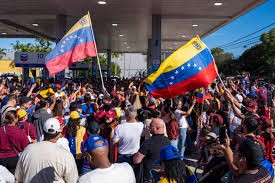
In Spain, thousands of people gathered at Madrid’s Puerta del Sol and applauded as they watched Trump’s press conference live.
In the afternoon, groups of Venezuelans gathered to celebrate in Argentina’s capital Buenos Aires.
Venezuelans in Columbia, Chile, Argentina and the United States to name a few are celebrating the fall of the dictator they call Nicolás Maduro and the era of a new and free Venezuela.
Despite the celebrations, some Venezuelans have expressed fear and uncertainty about the future of their country.
“They got him, but the criminals are still there,” said Coronel, who is a 54-year-old employee at an immigration law practice.
“There’s no new government. Everything’s exactly the same,” said Coronel.
A number of Venezuelans have also protested against U.S actions, calling it unjustified and aggressive.
“I don’t agree with this, no matter what happened, whatever it was. They have their problems, and we have ours. Now look at all this chaos. I don’t agree with this, gentlemen.” Said a Venezuelan official at the New York Times, Jonatan Mallora.